




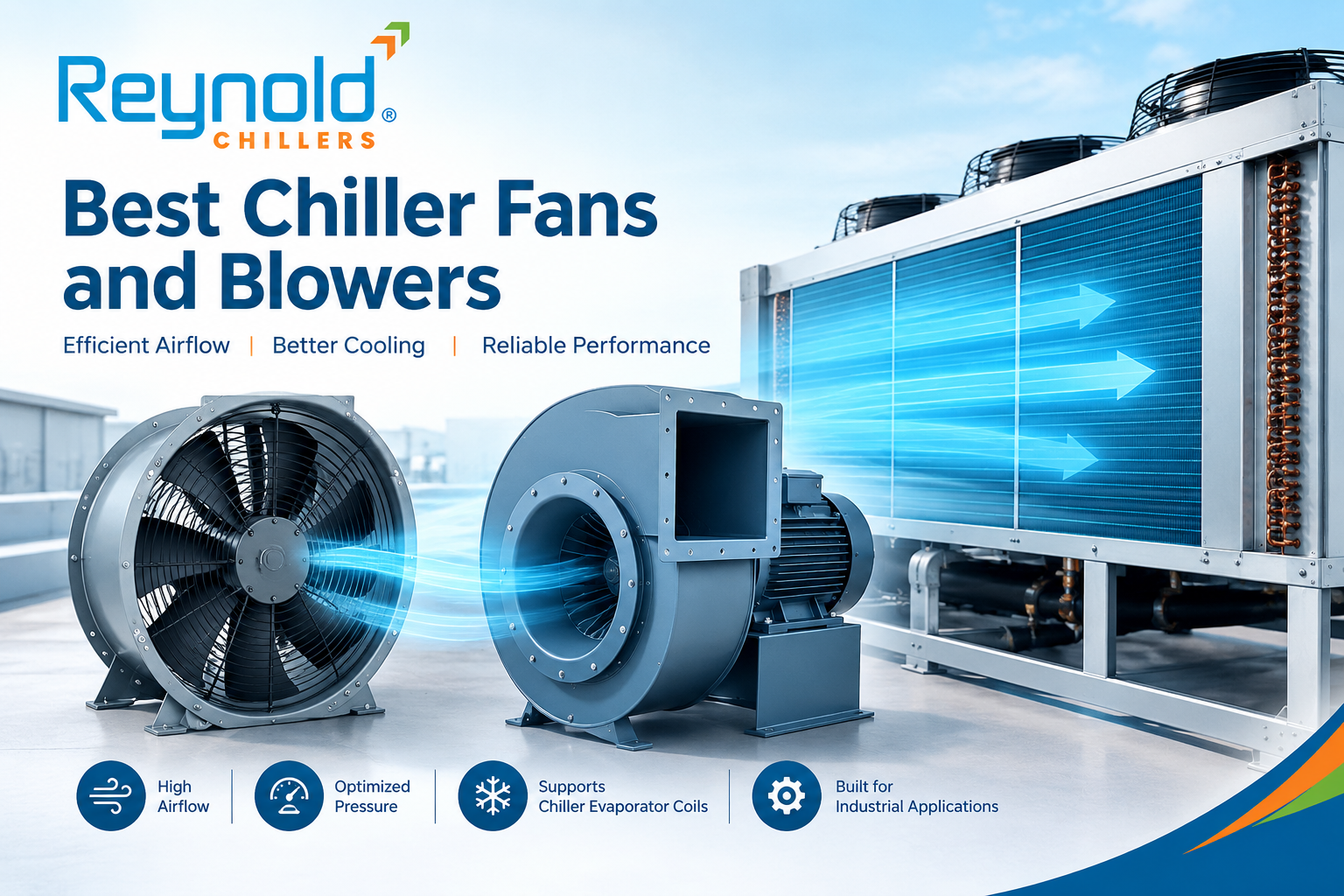
Best Chiller Fans and Blowers: Selection Guide, Benefits, Applications and Buying Tips
Efficient airflow is an important part of many industrial and commercial cooling systems. While the chiller is responsible for removing heat, fans and blowers help move air through the system, supporting heat transfer and maintaining consistent operating conditions. Choosing suitable equipment can therefore influence airflow, temperature management, maintenance requirements and overall system performance.
This guide explains what to consider when selecting the Best Chiller fans and blowers, how they work with chiller evaporator coils, where they are used, and what buyers should evaluate before purchasing equipment in India.
What Are Chiller Fans and Blowers?
Chiller fans and blowers are air-moving components used in cooling equipment and associated HVAC or industrial systems. Their primary function is to move air at the required volume and pressure through designated sections of the system.
Although the terms fan and blower are sometimes used interchangeably, their operating characteristics can differ. Fans generally move larger volumes of air at comparatively lower pressure, while blowers are commonly selected when the application requires greater pressure to overcome resistance in the airflow path.
The appropriate choice depends on factors such as:
- Required airflow
- Static pressure
- System resistance
- Operating temperature
- Available installation space
- Noise requirements
- Duty cycle
- Environmental conditions
- Motor and electrical requirements
For this reason, the best solution is not necessarily the largest fan or blower. It is the one correctly matched to the cooling system and operating conditions.
How Do Chiller Fans and Blowers Work With Evaporator Coils?
Chiller evaporator coils are involved in transferring heat from the process fluid or air to the refrigerant, depending on the chiller configuration. Airflow across a coil can be particularly important in air-side cooling arrangements.
A simplified airflow process is:
Fan or blower → Air movement → Evaporator coil → Heat transfer → Conditioned or cooled air
When airflow is appropriate, the coil can receive the air volume it was designed to handle. If airflow is too low, heat transfer may be affected. Excessively high airflow, on the other hand, may not necessarily improve the overall system and can increase energy consumption or create unwanted noise and pressure losses.
This is why fan selection should be considered together with the coil design, ductwork, filters, heat exchanger arrangement and overall system requirements.
Key Features to Consider in Chiller Fans and Blowers
When comparing chiller airflow equipment, buyers should look beyond basic fan size.
1. Airflow Capacity
Airflow is usually one of the first parameters to evaluate. The required airflow should correspond to the cooling system’s design conditions rather than being selected simply by physical fan size.
2. Static Pressure
The fan or blower must be capable of overcoming resistance from components such as:
- Ducts
- Filters
- Coils
- Grilles
- Dampers
- Heat exchangers
A fan with suitable airflow but insufficient pressure capability may not deliver the required performance once installed.
3. Motor Compatibility
Motor selection should match the required duty and electrical conditions. Important considerations can include voltage, frequency, power requirements, operating environment and control method.
4. Space and Installation
Industrial equipment may have strict dimensional constraints. Check mounting arrangements, available clearance, airflow direction and accessibility for maintenance before finalizing the equipment.
5. Noise and Vibration
For facilities where operating noise matters, fan speed, blade design, mounting and system configuration should be considered together.
6. Operating Environment
Dust, humidity, temperature and other site conditions can affect the appropriate fan or blower configuration. Industrial applications may require equipment selected specifically for their environment.
7. Maintenance Accessibility
A practical design should allow routine inspection and cleaning. Easy access can be particularly useful where filters, coils or airflow paths require periodic attention.
Benefits of Properly Selected Chiller Fans and Blowers
Correct fan and blower selection can provide several practical advantages.
Better Air Distribution
Appropriate airflow helps distribute cooled air more consistently through the intended system or process.
Support for Heat Transfer
When airflow across an air-side coil is correctly matched to the system, it can support effective heat exchange.
Reliable Operation
Selecting equipment according to actual operating conditions helps avoid problems caused by undersized or incorrectly applied airflow equipment.
Easier Maintenance
A properly specified system can make inspection, cleaning and replacement more manageable.
Improved System Matching
Fan selection should complement the evaporator coil, ductwork, heat exchanger and other components rather than being considered as an isolated product.
Applications of Chiller Fans and Blowers
Chiller fans and blowers can be relevant to a wide range of cooling and air-handling applications, depending on system design.
Common applications include:
- Industrial process cooling
- HVAC and air-conditioning systems
- Manufacturing facilities
- Plastic processing
- Pharmaceutical facilities
- Food and beverage processing
- Chemical processing
- Cold-storage-related systems
- Data and equipment cooling
- Air-handling systems
- Process temperature-control systems
The exact fan or blower configuration should always be determined by the requirements of the particular installation.
Industries That Use Chiller Air-Moving Systems
Plastic Industry
Plastic processing equipment can generate significant process heat. Cooling systems may use fans, blowers and heat-transfer components as part of the overall temperature-control arrangement.
Pharmaceutical Industry
Temperature control can be important across manufacturing and processing environments. Air-moving equipment may form part of HVAC or process-cooling systems.
Food and Beverage Industry
Cooling and temperature management are used in various food and beverage processes. Fan and blower selection depends on the particular cooling configuration.
Chemical Industry
Chemical processes can have specific temperature-control requirements. Equipment selection should consider process conditions and the surrounding operating environment.
General Manufacturing
Industrial facilities may use chillers and air-handling equipment for machinery, processes, workspaces or dedicated temperature-control applications.
How to Select the Best Chiller Fans and Blowers
The phrase Best Chiller fans and blowers should be approached from an application perspective. Instead of selecting equipment based only on brand or price, evaluate the complete operating requirement.
Step 1: Define the Required Airflow
Determine the airflow needed by the system under actual operating conditions.
Step 2: Determine Static Pressure
Account for resistance from coils, ducts, filters and other components. This is particularly important in systems with long or complex airflow paths.
Step 3: Check Coil Requirements
Review the characteristics of the chiller evaporator coils or other heat-transfer surfaces involved in the airflow path.
Step 4: Consider Operating Conditions
Identify temperature, humidity, dust exposure, operating hours and other environmental factors.
Step 5: Review Installation Constraints
Check dimensions, mounting arrangement, airflow direction, access and available service space.
Step 6: Evaluate Energy and Noise Requirements
Where equipment operates continuously, fan efficiency and operating characteristics can become important considerations.
Step 7: Discuss the Complete System
A fan or blower should ideally be evaluated as part of the complete chiller or air-handling system. Reynold India can be considered when discussing industrial cooling requirements and the appropriate configuration for a specific application.
Why Application-Based Selection Matters
There is no universal fan or blower that is automatically suitable for every chiller.
For example, a compact system with low airflow resistance may require a different configuration from an industrial installation with long ductwork, multiple filters and significant static pressure.
Similarly, the requirements for a process cooling system may differ from those of a comfort HVAC application.
Therefore, buyers should provide relevant operating information before finalizing a selection. This can help the supplier assess the application rather than recommending equipment based solely on a generic product category.
Common Mistakes to Avoid
Choosing Only by Fan Size
Physical dimensions do not tell the complete performance story. Airflow and pressure requirements should be evaluated together.
Ignoring System Resistance
Filters, coils and ductwork can significantly affect the required pressure capability.
Selecting an Oversized Unit
More airflow is not automatically better. Oversizing can affect energy use, noise and system balance.
Forgetting Maintenance Access
A component that is difficult to inspect or clean can create avoidable maintenance challenges.
Focusing Only on Purchase Price
The initial price is only one consideration. Application suitability, operating requirements, maintenance and system compatibility should also be reviewed.
Why Consider Reynold India?
Reynold India works in the industrial cooling and chiller segment, where system requirements can vary considerably between applications. For businesses evaluating chiller-related equipment, the selection process should begin with the required cooling conditions, airflow requirements and installation environment.
Rather than treating Best Chiller fans and blowers as a one-size-fits-all category, buyers can discuss their application requirements with a suitable cooling-system supplier to determine the appropriate configuration.
FAQ About Chiller Fans and Blowers
1. What are chiller fans and blowers used for?
They are used to move air through cooling or air-handling systems. Depending on the system design, they can support airflow across coils and other heat-transfer components.
2. How do fans affect chiller performance?
Appropriate airflow can support heat transfer and air distribution. However, fan performance needs to be matched to the coil, pressure losses and overall system design.
3. What is the difference between a fan and a blower?
Fans generally provide high air volume at relatively lower pressure, while blowers are commonly used where higher pressure is required to overcome system resistance.
4. How do I choose the best chiller fan or blower?
Start with the required airflow and static pressure, then consider coil characteristics, operating conditions, motor requirements, installation space, noise and maintenance needs.
5. What information should I provide when buying a chiller blower?
Useful information includes required airflow, static pressure, operating temperature, electrical conditions, installation dimensions, application, operating environment and details of the connected cooling system.
Frequently Asked Questions
1. Are chiller fans and blowers the same thing?
Not exactly. Both move air, but they can be designed for different airflow and pressure requirements. The correct choice depends on the system.
2. Why are chiller evaporator coils important when selecting airflow equipment?
The coil is part of the heat-transfer path. Its design and airflow requirements should be considered when selecting a suitable fan or blower.
3. Can one fan be used for different chiller applications?
Not necessarily. Different applications can have different airflow, pressure, temperature and environmental requirements.
4. What is static pressure in a chiller airflow system?
Static pressure represents the resistance that the fan or blower needs to overcome to move air through components such as ducts, filters and coils.
5. Are blowers suitable for industrial cooling systems?
They can be, depending on the required airflow, pressure and system configuration. Selection should be based on the actual application.
6. How can I reduce fan-related maintenance problems?
Correct sizing, suitable installation, accessible mounting, regular inspection and keeping airflow paths and associated components clean can help support reliable operation.
7. Should fan selection be done before selecting the chiller?
Ideally, airflow equipment should be considered as part of the complete system design. Chiller, coil, airflow and installation requirements should work together.
8. Can Reynold India help with chiller-related requirements?
Reynold India can be approached to discuss industrial cooling requirements and determine what type of chiller configuration may be appropriate for a particular application.